
Enterprise Performance Management: Why Better Business Decisions Matter More Than Better Plans
Table of Contents
Toggle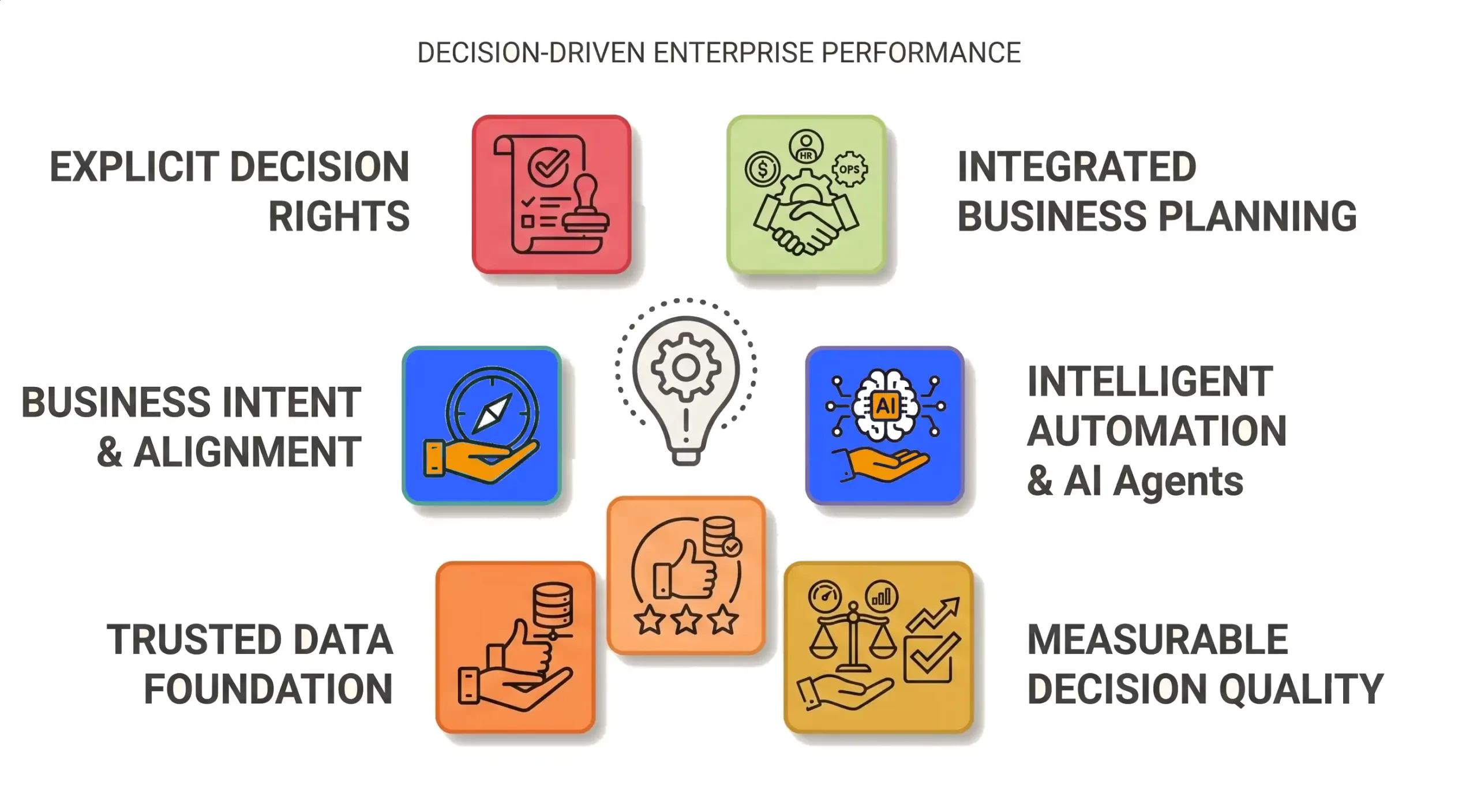
For most of its history, Enterprise Performance Management has been defined by what it produces. Plans. Budgets. Forecasts. Reports. Dashboards. Variance analysis. The implicit assumption has always been that better outputs will automatically lead to better business outcomes. Produce a more accurate forecast, and better decisions will follow. Close the books faster, and strategic clarity will improve. Automate more, and the business will become more agile. The assumption has never been rigorously tested. And for a growing number of CFOs, the results are beginning to tell a different story.
Finance functions have never been more technically capable. Models are more sophisticated. Forecasts are more frequent. Dashboards arrive in real time. AI is generating variance narratives before a human analyst has opened a spreadsheet. And yet, when senior leaders are asked honestly not in an earnings call, but in a quiet conversation whether their organization makes better business decisions because of their Enterprise Performance function, the answer is rarely the confident yes the investment deserves.
Something is not connecting. And the gap is not where most organizations look for it. Enterprise Performance exists to improve business decisions. Not plans. Not reports. Not dashboards. Decisions. This shift reflects the evolution of Enterprise Performance from a reporting discipline into a strategic management capability, as explored in Why Modern Enterprises Need Enterprise Performance Management (EPM) to Accelerate Performance, Agility, and Better Decision-Making. This single reorientation changes almost everything about how an Enterprise Performance function should be designed, measured, and led. Organizations seeking to redesign Enterprise Performance around management intent should first understand the principles that govern effective planning systems through Enterprise Performance Frameworks
The Biggest Assumption Holding Enterprise Performance Management Back
There is a core assumption embedded in how most Enterprise Performance functions operate, and it is so foundational that almost nobody examines it directly.
The assumption is this: if the numbers are right, the decisions will follow.
Produce an accurate forecast, and leaders will make better resource allocation decisions. Generate a detailed variance report, and managers will take the right corrective actions. Build a sophisticated scenario model, and the executive team will choose the right strategic path. The numbers are the output. The decisions are assumed. This assumption breaks down in practice because it ignores the design question that should precede every planning output.
- What decision is this number designed to improve?
- Who makes that decision, and what information do they need to make it with confidence?
- How will they act differently because this output exists?
When these questions go unasked and in most organizations they are never asked explicitly the Enterprise Performance function produces outputs that are technically correct and strategically disconnected. The forecast is accurate. The executive team does not reference it when allocating capital. The variance report reconciles perfectly. The management team does not change its behavior. The dashboard is comprehensive. Nobody knows which number to act on.
This is not a data problem. It is a design problem.
Why Enterprise Performance Management Exists to Improve Business Decisions
The decision is the unit of value in Enterprise Performance. Not the plan. Not the report. The business decision that the plan, report, or forecast was meant to inform. If the quality of that decision does not improve, if it is not made faster, with greater confidence, or with better information than before the planning investment has not delivered value, regardless of how sophisticated the model was or how quickly the close cycle ran. This same philosophy also changes how finance organizations should be designed. A modern FP&A Operating Model positions Finance as a decision-support capability rather than a reporting function. High-performing finance organizations increasingly redesign FP&A around this principle by treating decision quality as the primary outcome of planning rather than reporting.
This reorientation carries significant implications for how an Enterprise Performance function is designed. If the decision is the unit of value, then the first design question is not “what planning process should we use?” It is “what decisions does this process need to improve?” That question cannot be answered by a finance team working alone. It requires a genuine conversation with the leaders who make the decisions the process is meant to serve.
If the decision is the unit of value, then the primary measure of planning success is not forecast accuracy or close cycle speed. It is whether the leaders who received the planning output made a better decision because of it, a decision they would not have made, or would have made differently, without the information finance provided.
And if the decision is the unit of value, then every component of the Enterprise Performance system; the planning model, the forecasting cadence, the reporting architecture, the technology platform should be evaluated by how directly it serves the decisions that matter most to the business.
The Four Components of an Intelligent Enterprise Performance Management System
Enterprise Performance does not begin with a plan and end with a report. That framing is precisely the limitation the profession has been working inside for decades. An enterprise performance system that exists to improve decisions is built on four components that must work together as an adaptive whole.
Business intent is the starting point. What decisions does this organization need to make? Who makes them? What information would change the quality of those decisions? These questions define everything that follows. Without clarity on business intent, the planning function has no anchor. It produces outputs in search of a purpose. Organizations translating business intent into coordinated execution often adopt Integrated Business Planning (IBP) to connect strategy, finance, operations, workforce planning, and execution through a single planning framework.
Planning, the process of translating intent into financial and operational commitments is one component, not the system. Planning succeeds when it is designed around the decisions it is meant to support. A planning process designed around a calendar is a production function. A planning process designed around decisions is a management function.
Trusted data is the foundation on which planning operates. Not all data. Not more data. Trusted data information that is clean, consistent, and credible enough that leadership will act on it without second-guessing the source. Organizations that deploy sophisticated planning technology on unresolved data foundations discover, quickly, that faster wrong numbers do not improve decisions.
Intelligent automation accelerates the system. Routine data collection, variance narrative generation, scenario refresh, exception flagging these are appropriate uses of automation and AI. But automation amplifies the design of the system it operates within. A well-designed Enterprise Performance system, powered by intelligent automation, produces better decisions faster. A poorly designed one produces worse decisions more efficiently. AI becomes valuable only after planning and data foundations are established. UVID’s perspective on Enterprise Performance AI Agents explores how intelligent automation should augment management decisions rather than replace them.
The relationship between these four components is not sequential. It is adaptive. Business intent informs planning design. Planning design determines data requirements. Data quality determines what automation can reliably do. The decisions that result feedback into a revised understanding of what the business needs to know next.
That is an Enterprise Performance system. It is not a planning cycle. It is not a reporting cadence. It is a continuously adaptive capability built for better decisions.
Why Enterprise Performance Management Extends Beyond Planning
One of the most limiting habits in Enterprise Performance is treating it as a planning discipline. Planning is how the organization commits to a direction. It is essential. But Enterprise Performance understood as a decision-enabling capability operates before planning begins and long after the plan is published.
Before planning begins, someone must ask what the plan is for. Which decisions will it inform? What management questions should it be designed to answer? These are not planning questions. They are intent questions. And they belong at the beginning of every Enterprise Performance initiative, before a methodology is selected or a model is opened.
After the plan is published, the work is only beginning. The forecast must provide an honest current view of where the business is heading. The latest estimate must tell leadership where it will land. Management reporting must translate financial data into the language of decisions, not the language of accounting. Scenario modeling must answer the questions leadership is actually asking, not the questions that were easiest to model.
Enterprise Performance is not a planning function with reporting attached. It is an end-to-end management capability. Planning is one instrument in that capability. So is forecasting. So is reporting. So is scenario analysis. Each instrument serves a different management conversation. Each must be designed around the management question it is meant to answer. And the discipline that connects them all the discipline that keeps the entire system oriented toward better decisions is Enterprise Performance.
How CFOs Can Transform Enterprise Performance Management into a Decision-Driven Capability
The reorientation from output-focused to decision-focused Enterprise Performance is not a technology project. It is not a process improvement initiative. It is a leadership question, one that the CFO is uniquely positioned to ask.
Three questions open the conversation.
What are the highest-value business decisions in this organization?
Not financial decisions alone. The decisions that most determine whether the organization succeeds or falls short of its potential. Capital allocation. Pricing. Workforce investment. Market entry and exit. These decisions exist. Most organizations have not explicitly named them or mapped them to the planning function.
What does the Enterprise Performance function currently deliver to those decision-makers?
What information reaches them, in what format, on what cadence? And is there evidence that it changes the quality or confidence of their decisions? Answering this question honestly is difficult. It often reveals that the planning function is delivering technically correct information to people who are not using it to make the decisions it was designed to support.
What would need to change for finance to directly improve the quality of those decisions?
This is the design question. It cannot be answered by selecting a better technology platform. It begins with understanding the management model who decides, what they need, and how they will act differently with better information. It ends with a planning system designed to serve that model.
What a Decision-Centric Enterprise Performance Management Function Looks Like
There are concrete markers that distinguish a decision-oriented Enterprise Performance function from one still oriented around outputs. Decision rights are explicit. The organization knows who makes which decisions, what information those decisions require, and who is responsible for providing it. The planning function is organized to serve those decision rights, not to produce outputs by schedule.
Planning instruments serve management questions, not categories. The budget answers the commitment question. The forecast answers the trajectory question. The latest estimate answers the landing question. Each instrument is distinct, designed for a different leadership conversation, and held to different standards of accuracy and revision.
Technology is selected to serve the management model, not to create one. The planning platform is configured around the decisions the business needs to make, not around the features the vendor demonstrated. The system is built to express the management model, not to define it. And the primary measure of Enterprise Performance is not how fast the close runs or how accurate the forecast was. It is whether the quality of business decisions improved whether leadership made better choices, with greater confidence, faster than before.
That is the Enterprise Performance function that CFOs in 2026 are being asked to build. Not a better planning department. An intelligent decision system.
The CFO’s Role in Transforming Enterprise Performance Management
The CFO is the only executive positioned to ask the question that makes this reorientation possible: what decisions is our Enterprise Performance system designed to improve?
It is not a technology question. The answer does not emerge from a platform selection process or a system implementation. It is a leadership question one that requires the CFO to convene the right conversations across the business, define decision rights explicitly, and hold the planning function accountable for the quality of decisions enabled, not just the quality of outputs produced.
This reorientation also changes how the CFO measures the finance team’s contribution. Not by close cycle speed. Not by forecast accuracy relative to actuals. By decision quality — the speed, confidence, and soundness of the business decisions the organization makes because the Enterprise Performance system exists.
Enterprise Performance has always had the potential to be the most strategically valuable function in the organization. The design problem — the one that has been defaulted on for decades is that it was built to produce outputs when it should have been built to enable decisions. That design problem is solvable. It begins with a different question at the start of every planning initiative, every technology investment, every reporting redesign.
Not: what should this process produce?
But: what decision should this process improve?
Enterprise Performance Management Begins with Better Business Decisions
The future of Enterprise Performance Management will not be defined by faster planning cycles, more sophisticated forecasting models, or increasingly intelligent technology. It will be defined by an organization’s ability to make better business decisions with greater speed, confidence, and clarity.
For too long, Enterprise Performance Management has been measured by the quality of its outputs; budgets, forecasts, reports, and dashboards. While these remain essential, they are not the ultimate objective. Their value lies in how effectively they enable leadership to allocate resources, manage risk, respond to change, and execute strategy.
This requires a fundamental shift in how Enterprise Performance Management is designed. Instead of beginning with methodologies, processes, or technology, organizations must begin with management intent. They must first define the decisions that matter most, understand the information required to support those decisions, and then design planning, forecasting, reporting, and data capabilities around those business needs.
As organizations continue to embrace AI, intelligent automation, and modern planning platforms, the competitive advantage will not come from technology alone. It will come from designing an Enterprise Performance Management capability that connects business intent, planning, trusted data, and intelligent automation into a unified decision system.
The organizations that lead tomorrow will not simply produce better plans, they will consistently make better business decisions. That is the true purpose of Enterprise Performance Management and the foundation of sustainable enterprise performance.
Table of Contents
ToggleFAQs
Enterprise Performance Management (EPM) is a strategic management capability that connects planning, budgeting, forecasting, reporting, and performance analysis to improve business decisions. Modern Enterprise Performance Management helps organizations align strategy, operations, and financial performance, enabling leadership to make faster, more informed decisions while improving organizational agility and long-term business performance.
Enterprise Performance Management improves business decision-making by providing leadership with trusted data, integrated planning, forward-looking forecasts, and performance insights that support strategic and operational decisions. Rather than simply producing financial reports, an effective EPM capability enables organizations to allocate resources more effectively, respond to changing market conditions, and manage business performance proactively.
What is the difference between Enterprise Performance Management and traditional financial planning?
Traditional financial planning primarily focuses on budgets, forecasts, and financial reporting. Enterprise Performance Management takes a broader approach by integrating financial and operational planning, performance management, data, and decision support into a connected management capability. Its objective is not only to improve planning accuracy but also to improve the quality and speed of business decisions.
An effective Enterprise Performance Management system is built on four core components: business intent, integrated planning, trusted data, and intelligent automation. Together, these capabilities enable organizations to connect strategy with execution, improve forecasting, strengthen governance, and support better executive decision-making across the enterprise.
CFOs can modernize Enterprise Performance Management by designing planning, forecasting, reporting, and performance management processes around the business decisions they are intended to support. Instead of beginning with technology or methodology, organizations should first define management objectives, decision requirements, and governance expectations before implementing modern planning platforms and intelligent automation.