
Budget vs Forecast vs Latest Estimate: Which Number Should Leadership Trust?
Table of Contents
Toggle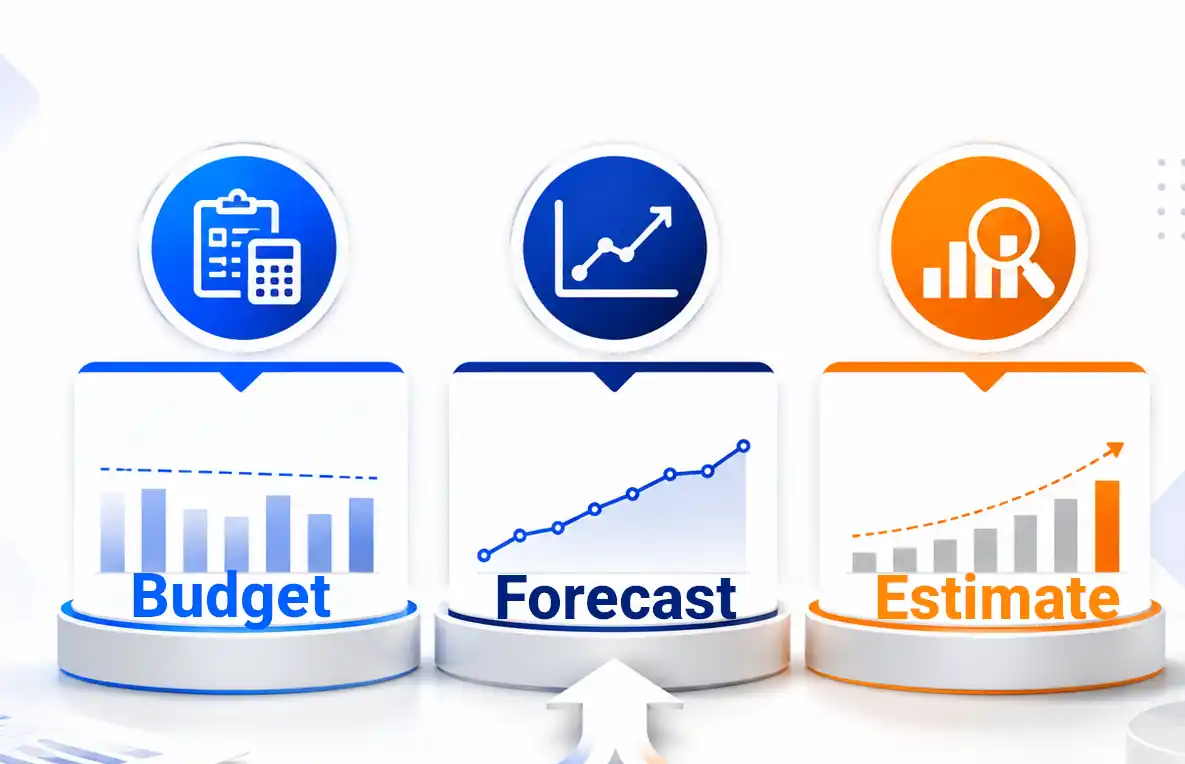
Budget, forecast, and latest estimate often appear to be different versions of the same financial outlook, but they serve fundamentally different management purposes. When these planning instruments are not clearly distinguished, Finance can produce accurate numbers while leadership remains uncertain about which number to use for accountability, trajectory, and near-term execution. This blog examines how CFOs and FP&A leaders can redesign these instruments around the management questions they are intended to answer, creating clearer financial signals and better decision support.
Three numbers often appear in the same leadership conversation: the approved budget, the latest forecast, and the latest estimate prepared by FP&A. Each reflects a different view of the business, yet when they point in different directions, leadership is often left asking which number represents the reality they should act on.
Finance can explain the variance between them, but the underlying uncertainty remains. The issue is not necessarily forecast accuracy, data quality, or the quality of management reporting. More often, it is a planning design problem.
The confusion begins when the budget, forecast, and latest estimate are treated as different versions of the same financial number rather than as distinct planning instruments designed to answer different management questions. When their purposes are not clearly defined, each can be technically correct while collectively creating an unclear picture of where the business stands and where it is heading.
Why Leadership Receives Three Different Financial Signals From the Same Planning Function
The budget projects $47 million in year-end revenue. The latest forecast, reflecting current trading conditions, points to $43 million, while the latest estimate indicates $44.5 million. Finance can explain why the numbers differ, yet leadership is left with a more fundamental question: which number should the business use to make decisions?
This situation is common in organizations where budgeting, forecasting, and latest-estimate processes have evolved independently. Each produces a technically defensible number, but when the purpose of each instrument is unclear, the combined picture becomes difficult for leadership to interpret.
The issue is rarely a lack of analytical capability within Finance. The deeper problem is that the three instruments were often designed around planning cycles rather than management questions, the budget during the annual planning cycle, the forecast when conditions change, and the latest estimate as another periodic update.
When planning instruments are built around when numbers are produced rather than why they are needed, their purposes begin to overlap. Finance ends up producing multiple financial views that may each be valid in isolation but collectively create uncertainty about what the business is committed to, where performance is heading, and where it is likely to land.
What Is a Budget and What Management Question Does It Answer?
A budget is a commitment instrument. It represents the organization’s formal commitment to a defined set of financial outcomes for a specific period. Once approved by leadership and endorsed by the board, it becomes the baseline for performance accountability, resource allocation, investment decisions, and, in many organizations, incentive structures.
Because the budget represents a commitment, its value depends on remaining relatively stable. If the budget changes every time trading conditions shift, it begins to function less like a commitment baseline and more like a forecast under a different name. Its purpose is to provide a fixed reference point against which actual performance can be evaluated and accountability maintained.
The management question the budget is designed to answer is:
What are we committed to delivering?
It is not designed to answer:
Where are we heading?
Nor is it designed to answer:
Where will we land this period?
Those questions belong to the forecast and latest estimate.
This distinction is often overlooked. When leadership asks why the budget differs from current trading conditions, it is effectively asking the budget to perform a function it was never designed to perform. The budget captures the organization’s commitments and intentions at a defined point in time; it is not intended to continuously reflect changing business conditions.
A budget that no longer matches current expectations is therefore not necessarily a failed budget. Its difference from the latest outlook can be precisely what makes it useful as a stable baseline against which the organization can understand performance, measure progress, and assess the gap between what it committed to deliver and where the business is now heading.
Why a Forecast Should Never Become a Budget Revision
A forecast is a learning instrument. It represents the organization’s most honest current view of where performance is heading, based on the latest information available about trading conditions, market dynamics, operational performance, and changing business drivers.
The forecast answers a different management question from the budget:
Given what we know today, where is the business heading?
That requires a fundamentally different discipline from budget production. The budget is anchored in commitment; the forecast is anchored in accuracy. A budget can deliberately stretch the organization toward higher performance. A forecast, however, must reflect the organization’s best assessment of what is likely to happen.
This distinction becomes critical when forecasts are treated as performance targets. If teams are held accountable for beating their forecast rather than using it as an honest view of future performance, they have an incentive to manage the number rather than improve its accuracy. The forecast gradually becomes a target instead of a source of insight.
An effective forecast should create the opposite behavior. When Finance and business leaders are encouraged to make the forecast as accurate as possible, they have a stronger incentive to surface changing conditions early, challenge assumptions, and give leadership a clearer view of the trajectory.
The management question the forecast answers is:
Given what we know today, where are we going?
It does not answer:
What are we committed to delivering?
That is the role of the budget.
Nor does it answer:
Where will we land this specific period?
That is the role of the latest estimate.
The distinction must also be protected in practice. When pressure is applied to make the forecast converge with the budget, both instruments begin to lose their purpose. The budget becomes less meaningful as a commitment baseline, while the forecast stops providing an independent and honest view of the future.
The result is not better alignment.
It is the loss of two distinct management capabilities: a stable baseline for accountability and an unbiased view of where the business is heading.
What the Latest Estimate Is Designed to Answer
The Latest Best Estimate (LBE) is an execution instrument. It answers a specific, time-bound management question:
Given everything we know today, where will we land at the end of this period?
Unlike the forecast, which looks across a rolling horizon to assess the broader trajectory of the business, the latest estimate focuses on the current month or quarter with as much precision as the available information allows.
It incorporates the most recent trading performance, orders already in hand, committed costs, and management actions already underway. Its purpose is not to project the business over the next twelve months. It is to give leadership the clearest possible view of where the current period is likely to close.
That capability becomes particularly important as a period-end approaches. Leadership needs to know whether corrective action is required, whether commitments made to the board remain achievable, and whether additional measures are necessary to close a performance gap.
The management question the latest estimate answers is:
Where will we land?
The problem is that many organizations have effectively absorbed this capability into the broader forecast. The forecast is updated regularly, its near-term periods are treated as the latest estimate, and the distinction between “Where are we heading?” and “Where will we land this period?” disappears.
When that distinction is lost, Finance loses an important management capability: providing leadership with a specific, current, and evidence-based view of the expected period-end outcome when timely intervention matters most.
The Management Questions Each Instrument Was Designed to Answer
The design principle is straightforward, even if applying it consistently requires discipline: each planning instrument should serve a distinct management conversation. It should be designed, governed, and presented around that purpose rather than being treated as another version of the same financial outlook.
Budget → What are we committed to delivering?
The budget serves the accountability question. It represents the organization’s formal financial commitment, approved by leadership and the board. Its value comes from providing a stable baseline against which performance and accountability can be assessed. Its purpose is not to continuously reflect changing trading conditions, but to preserve the integrity of the commitment against which actual performance is measured.
Forecast → Given everything we know today, where are we heading?
The forecast serves the trajectory question. It represents the organization’s most current and honest view of future performance, informed by updated business drivers, market conditions, and operational information. Its value depends on accuracy and independence from the accountability function of the budget. The forecast must be allowed to reflect changing expectations rather than being pressured to remain aligned with the original commitment.
Latest Estimate → Where will we land at the end of this period?
The latest estimate serves the execution question. It provides the most precise, shortest-horizon view of the expected period-end outcome. It supports the decisions leadership needs to make as a month or quarter approaches close including whether corrective action is required, whether commitments remain achievable, and whether escalation is necessary.
When these three instruments retain their distinct purposes, leadership receives three forms of clarity rather than three competing financial numbers. The budget establishes the commitment, the forecast reveals the trajectory, and the latest estimate provides the near-term landing point.
When organizations collapse them into a single planning output, the distinctions disappear. The result is often a financial view that is technically detailed but less useful for the three management conversations it was originally intended to support.
The Risks of Treating Budget, Forecast and LBE as One
When the budget, forecast, and latest estimate are treated as one planning conversation, three predictable problems emerge.
Accountability confusion: When the forecast changes to reflect current business conditions, leadership may interpret the movement as a revision to the original budget commitment. Finance then spends time explaining that the forecast has changed without changing the budget, while leadership continues to view the difference as a failure against the original plan. The underlying issue is structural: when the commitment instrument and trajectory instrument are not clearly differentiated, they can become indistinguishable in leadership discussions even when they remain separate within the planning system.
Forecast sandbagging: When the forecast becomes a performance target or when teams are judged against their forecast rather than its accuracy against actual outcomes, people have an incentive to manage the number conservatively. Expected performance is understated to reduce the risk of missing the forecast they submitted. Over time, the forecast becomes a protective floor rather than an honest view of future performance, weakening one of its most important purposes: providing an early signal when the business trajectory is changing.
Leadership distrust of financial outputs. When budget, forecast, and latest estimate appear to tell different stories without a clear explanation of why each exists and which management question it answers, leadership can lose confidence in all three. Executives may increasingly rely on judgment, override model-based recommendations, or bypass Finance when making decisions that should be informed by financial analysis.
That response is understandable. When financial outputs appear contradictory, relying on judgment can seem safer than relying on numbers whose purpose is unclear.
The solution is therefore not simply to produce more accurate numbers or additional reporting. It is to design distinct financial instruments with clearly defined purposes, so leadership knows exactly which number to use for commitment, trajectory, and near-term execution.
How CFOs Can Redesign Planning Around Management Intent
The redesign begins with a conversation that many planning transformations overlook. Before changing models, workflows, or technology, leadership needs to establish a fundamental question:
What management question is each planning instrument designed to answer?
The organization should also determine whether the leaders who rely on these outputs clearly understand which instrument to use for each question. This is a management question before it is a Finance or technology question. It requires the CFO to bring Finance and the business leaders who depend on planning information into the same conversation and establish explicit agreement on the purpose of each instrument, how it should be used, and who is accountable for maintaining its integrity.
The budget should be protected as the commitment baseline. Any mid-year revision should require deliberate governance and formal approval rather than occurring automatically whenever trading conditions change. The forecast should be protected as an honest view of the business trajectory. Its accuracy should be evaluated against actual outcomes rather than its proximity to the budget. When a forecast misses, the first question should be “What changed in the underlying drivers?” rather than “Why did the business miss the plan?”
The latest estimate should be established as a distinct, high-precision execution instrument. If the organization currently relies on the forecast to provide this view, formally establishing an LBE can add an important capability to the planning architecture giving leadership a specific view of where the current period is expected to close and where intervention may still be possible.
How Technology Should Support Budget, Forecast and LBE
Modern planning platforms can maintain budget, forecast, and latest estimate as distinct planning instruments, with separate data structures, governance rules, workflows, and reporting views.
The challenge is that technology can just as easily collapse those distinctions. A forecast may be updated monthly, with near-term periods functioning as the latest estimate and prior-year actuals included for context. All three instruments can then appear together in a single report. The information exists, but the management purpose behind each number becomes unclear.
This is where technology reflects the quality of the underlying planning design. When management intent is clearly defined, a planning platform can reinforce the distinctions between the three instruments maintaining appropriate governance, workflows, and reporting for each and presenting them within the context of the management question they are designed to answer.
When that design clarity is missing, the same technology can produce increasingly sophisticated reports that place budget, forecast, and latest estimate side by side without helping leadership understand which number answers which question.
The problem is therefore not a lack of technology. It is a lack of planning design. Technology does not resolve an unclear management model. It amplifies it, making the outputs faster to produce, easier to distribute, and more sophisticated to visualize, while potentially leaving the underlying confusion unchanged.
Table of Contents
ToggleFAQs
Budgeting establishes financial targets, allocates resources, and creates organizational commitment for a defined period. Forecasting continuously updates expectations based on changing business conditions to help leaders make informed decisions. While budgeting focuses on what the organization intends to achieve, forecasting provides insight into where performance is heading.
No. The budget and forecast serve different purposes. The budget is a stable commitment baseline, while the forecast should provide an honest and unbiased view of expected future performance. Forcing the forecast to match the budget can reduce its usefulness as an early-warning instrument.
LBE is a short-horizon, high-precision planning instrument focused on the expected period-end outcome. It incorporates the latest trading information, orders, committed costs, and management actions to answer: “Where will we land?”
Keeping them distinct prevents accountability confusion, forecast sandbagging, and declining trust in financial outputs. Each instrument answers a different management question: commitment, trajectory, or execution.
Technology can maintain separate versions, workflows, governance, and reporting views, but it cannot determine what each instrument should mean. Management intent and planning design must come first; technology should then reinforce those distinctions.